
Workflow guide
Design a travel inquiry-to-proposal workflow that keeps its context
A practical checklist for turning client or partner inquiries into reviewed itineraries, prices and proposals without rebuilding the request at every revision.
Published
The short answer
Written for: Travel agencies, tour operators and DMC teams handling custom requests
A reliable inquiry-to-proposal workflow keeps the original request, clarifications, supplier choices, itinerary, price, files, approvals and follow-ups in one place. Capture everything at intake, resolve open questions before you build, change the itinerary and the price together, review against a fixed checklist before anything is sent, and hand the accepted version to operations as it is. Software can prepare and synchronize this work; a travel professional still approves the trip logic, the price and every commitment.
1. Capture the whole request at intake
Do not reduce a detailed request to a short CRM note. Keep the original message and its attachments, and record the details the itinerary and the price will depend on. The first output should be a clear summary and a list of missing information, not a polished proposal built on hidden assumptions.
- Travel dates and how flexible they are
- Number of travelers, ages and rooming
- Budget or price expectation, and the currency
- Accommodation standard and room preferences
- Interests, must-see places and preferred pace
- Mobility, dietary and other special requirements
- Arrival and departure flights or points
- Decision deadline and who makes the decision
- Source channel, client or partner account, and the owner on your team
- Attached files, such as previous programs or partner briefs
2. Resolve open questions before you build
List every assumption and unanswered question, then send one consolidated clarification instead of several partial replies. Record the answers on the same request so the next person does not ask again.
3. Change the itinerary and the price together
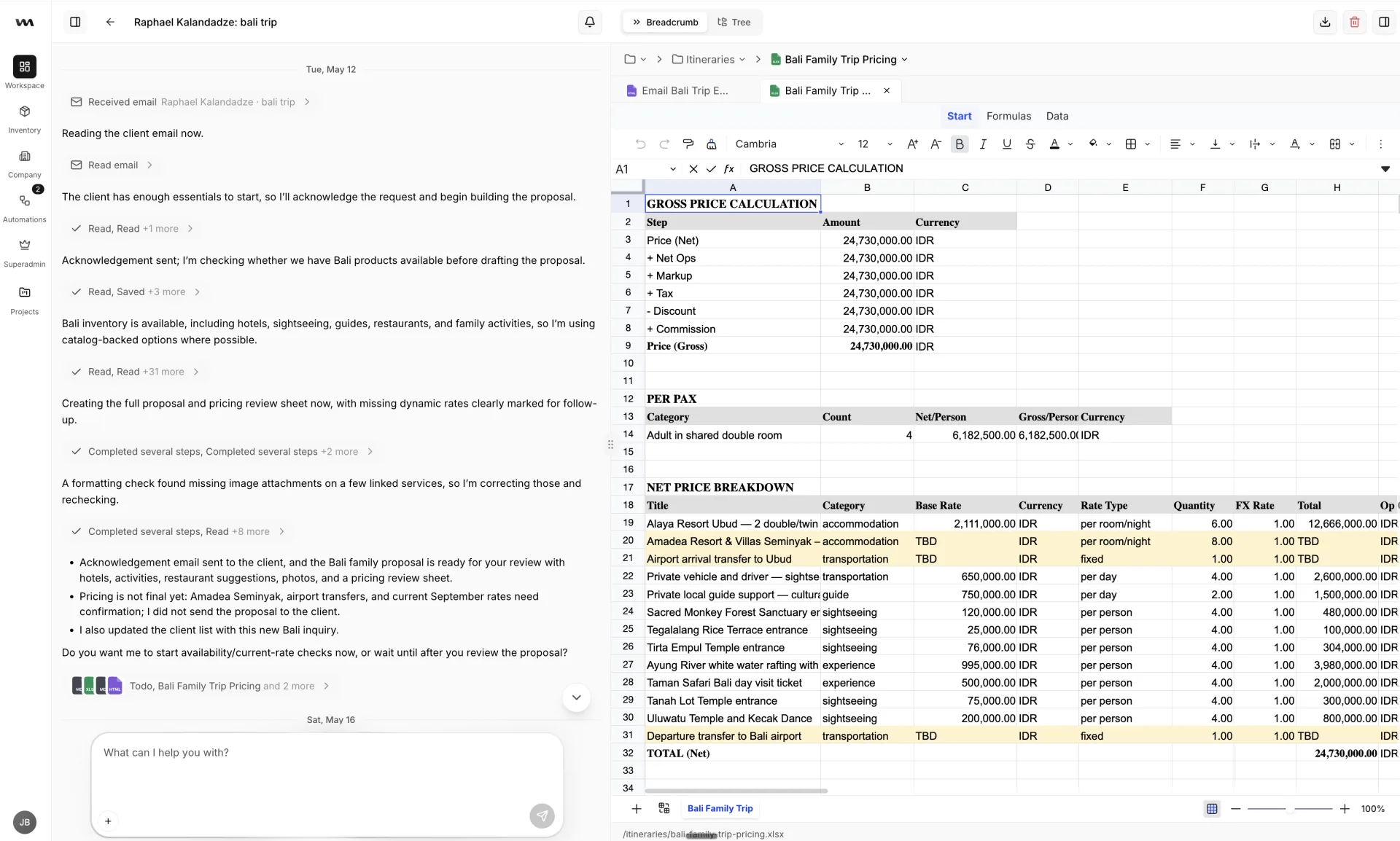
Dates, group size, hotels, transfers, activities and inclusions change both the program and the price. Treat the itinerary, the calculation and the client-facing proposal as one piece of work, so a revision never leaves an old price in a new document.
Keep a short version log for every revision: what changed, who asked for it and when. Never edit the client document by hand after pricing; change the source and regenerate it.
4. Review against a fixed checklist before sending
Approval should be explicit and attributable. It should not be assumed because a complete-looking draft exists.
- Trip logic: distances, driving times, check-in times and opening or closing days
- Price: your company's margins, supplements and rules applied
- Inclusions and exclusions written out
- Availability assumptions stated, with an option or validity date
- Payment and cancellation terms attached
- Recipient, tone and language checked
5. Hand the accepted version to operations
When the client or partner accepts, the accepted itinerary, suppliers, documents, messages and open tasks should move to operations as they are. If operations has to rebuild the booking from emails, the workflow is not finished.
Where Wandero fits
- Wandero reads and replies across Gmail, Outlook, Zoho and WhatsApp, so intake starts from the original message.
- It builds, prices and shares trips with 4M+ hotels, transfers in 180+ countries and your own supplier catalogue.
- People can approve, edit or reject work before it goes out, and actions, decisions and history stay reviewable.
What customers say
“Romania is a large country with many possible routes, combinations and seasonal considerations, so building the right itinerary can involve 20-30 emails, several versions and changing group structures before everything is finalized.”
“It allows our team to work on multiple client requests simultaneously without compromising the quality or detail of our responses.”
Limitations
- Connected context does not guarantee supplier availability or remove the need to check commercial details.
- A generated proposal is a draft until the responsible person approves it.
- The right integrations and approval points depend on each company's process.
Related resources
Build travel itineraries from the conversation and company context
Create, price, revise, and share client-ready travel itineraries using inquiry context, connected inventory, and your own supplier catalogue.
Prepare travel quotations without separating pricing from the trip
Connect inquiry details, supplier options, itinerary content, pricing, inclusions, exclusions, proposal files, revisions, and approvals in one workflow.
Turn travel inboxes into an organized operating queue
Connect Gmail, Outlook, Zoho, and WhatsApp so travel inquiries, supplier messages, drafts, files, ownership, and next actions share the same context.
Tour operator software compared by the work it is built for
A dated, Wandero-authored comparison of four kinds of tour operator software, with vendor facts from each vendor's own site and questions to ask in a demo.
How Panama Your Way works on several client requests at once
Leszek (Les) Glanas of Panama Your Way on answering detailed client requests and preparing itineraries and client presentations with Wandero.
